

Right Saw Blade for Every Job

Choosing the right Saw Blade can make a major difference in cutting accuracy, surface finish, production speed, and tool life. Whether you work with wood, plywood, MDF, laminates, panels, composites, or other industrial materials, the correct blade helps your machine deliver consistent results while reducing waste and downtime.
Today, manufacturers, furniture companies, woodworking professionals, and industrial workshops use specialized cutting solutions for different applications. For example, a PCD Saw Blade can handle demanding panel materials, while a TCT Saw Blade offers reliable performance for general industrial cutting. Similarly, a Diamond Saw Blade works well when manufacturers require high durability and clean cutting performance.
However, selecting the right blade is not simply about choosing a product with more teeth or a harder cutting edge. Instead, you should consider the machine, material, cutting speed, required finish, blade diameter, tooth configuration, and production requirements.
For businesses looking for dependable industrial cutting solutions, understanding these factors can help reduce operating costs and improve overall productivity.
Why the Right Saw Blade Matters for Industrial Cutting
A professional cutting operation needs more than a powerful machine. The right Saw Blade improves cutting accuracy, edge quality, production speed, and material utilization. It also helps operators achieve consistent results with less machine stress.
01. Cleaner Cuts and Better Edge Quality
The correct Saw Blade delivers smooth, accurate, and clean cuts across different materials. It reduces chipping, splintering, burning, and rough edges, helping manufacturers maintain a better final product finish.
02. Reduced Machine Load and Safer Operation
A properly selected blade cuts efficiently without unnecessary pressure on the machine. This reduces vibration, motor strain, overheating, and operator effort while supporting safer daily operations.
03. Lower Waste and Better Cost Efficiency
Using the right blade reduces damaged material, repeat cutting, and production delays. Its longer cutting life and consistent performance help businesses control operating costs and improve overall productivity.
Key Factors to Consider Before Buying a Saw Blade
Before purchasing a blade, first identify the material you need to cut. Next, check your machine type, spindle speed, blade diameter, bore size, feed rate, and required finish.
You should also consider how frequently the blade will operate. For high-volume production, durability and resharpening capability can become particularly important.
01. Material Type
Different materials require different cutting geometries. Wood-based panels, laminated boards, composites, and other industrial materials can respond differently during cutting.
Therefore, matching the blade to the material helps achieve better results and prevents premature wear.
02. Machine Compatibility
A blade must match the machine on which it will operate. For instance, panel processing equipment may require a Panel Saw Blade, while beam saw applications commonly use a Beam Saw Blade designed around the machine’s cutting requirements.
Always verify the blade diameter, bore, kerf, RPM rating, and machine specifications before installation.
03. Tooth Configuration
Tooth geometry directly affects cutting quality. The number of teeth, tooth shape, hook angle, and cutting-edge material all influence performance.
A higher tooth count can support a smoother finish in suitable applications. On the other hand, a lower tooth count can provide faster material removal when rough or high-speed cutting is required.
Types of Saw Blades for Different Applications
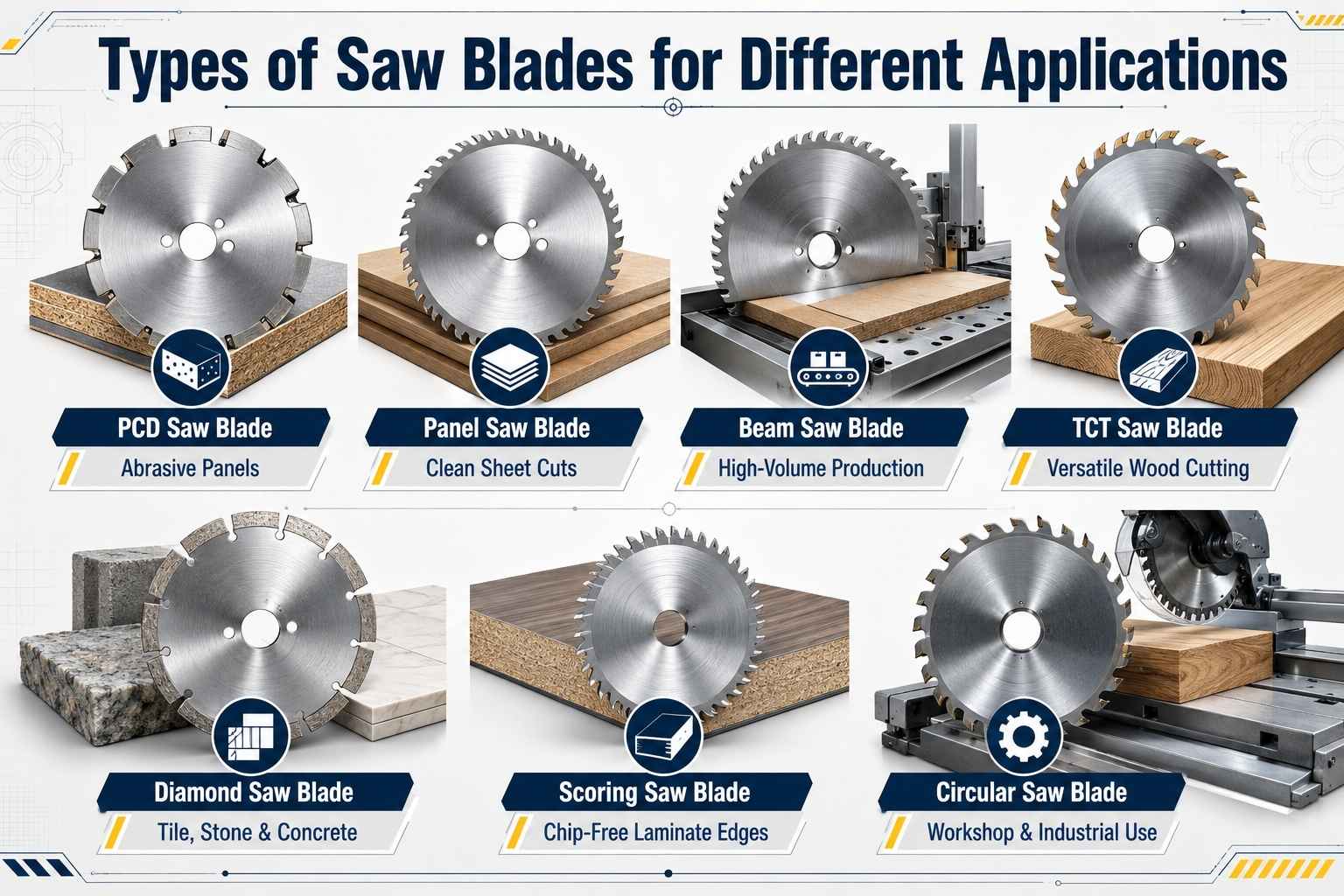
Modern industrial cutting requires more than one blade type. The right Saw Blade depends on the material, machine, production volume, desired edge quality, and cutting speed. Selecting the correct blade helps reduce waste, improve finishing, and maintain consistent performance.
01. PCD Saw Blades for Panel and Industrial Materials
PCD Saw Blades use polycrystalline diamond cutting edges, which offer excellent wear resistance for abrasive boards and engineered panel materials. They are commonly used for laminated MDF, particleboard, HDF, composite panels, and coated boards.
They are a suitable choice when production requires:
- Long blade life in continuous operations
- Consistent edge quality on abrasive materials
- Fewer blade changes and less machine downtime
- Reduced chipping on laminated surfaces
For high-volume panel processing, PCD technology can be cost-effective over time. However, the blade must match the board type and machine settings to deliver the expected performance.
02. Panel Saw Blade for Accurate Panel Processing
A Panel Saw Blade is designed for clean and precise cutting of sheet materials. Furniture manufacturers, modular kitchen units, woodworking workshops, and panel-processing businesses use it for MDF, plywood, laminate, veneer boards, and particleboard.
A suitable panel blade helps achieve:
- Clean and straight cuts
- Better dimensional accuracy
- Reduced edge chipping
- Consistent finish across multiple panels
The tooth count, kerf thickness, and blade geometry should be selected according to the panel material and required finish. For premium laminated boards, using a matching scoring blade can further improve the cut quality.
03. Beam Saw Blade for High-Volume Production
A Beam Saw Blade is made for industrial beam saw machines that process a large quantity of boards in a short time. These blades must handle continuous cutting while maintaining accuracy across every sheet.
A well-matched beam saw solution can support:
- High cutting accuracy
- Stable performance during long production shifts
- Smooth panel edges
- Lower material rejection
- Efficient high-volume processing
Blade selection should always consider the machine RPM, board thickness, feed speed, and whether a scoring saw is used with the main blade.
04. TCT Saw Blade for Versatile Cutting
A TCT Saw Blade has tungsten carbide-tipped teeth. It is one of the most practical options for woodworking and general industrial cutting because it provides good durability and reliable cutting performance.
Depending on its tooth design, a TCT blade can be used for:
- Solid wood cutting
- Plywood and MDF processing
- Crosscutting and ripping applications
- General workshop and furniture manufacturing work
- Clean finishing or faster material removal
TCT blades can often be resharpened, which makes them a practical choice for businesses that need dependable performance without the higher initial cost of specialized PCD blades.
05. Diamond Saw Blade for High-Durability Cutting
A Diamond Saw Blade uses diamond particles as its cutting surface. It is suitable for hard and abrasive materials where normal carbide teeth may wear quickly. Common applications include tiles, stone, concrete, fiber cement boards, ceramics, and selected composite materials.
Choose a diamond blade based on:
- Material hardness and density
- Dry-cutting or wet-cutting requirement
- Blade diameter and machine compatibility
- Required cutting speed
- Segment or rim design
Not every diamond blade is suitable for every hard material. The correct specification is important for clean cutting, longer blade life, and safer operation.
06. Scoring Saw Blade for Clean Panel Edges
A Scoring Saw Blade works with the main blade in panel saw and beam saw machines. It creates a shallow pre-cut on the bottom surface of laminated boards before the main blade completes the cut.
This helps deliver:
- Reduced chipping on lower laminate surfaces
- Cleaner panel edges
- Better finish for modular furniture components
- Less rework and material wastage
Proper alignment between the scoring blade and main blade is essential. Even a quality scoring blade may not give clean results if the machine setup is inaccurate.
07. Circular Saw Blade for General and Industrial Cutting
A Circular Saw Blade is widely used in woodworking machines, construction, manufacturing, and industrial workshops. It is available in different diameters, tooth counts, kerf sizes, and tooth geometries, allowing users to choose according to the job.
When selecting a circular blade, check:
- Material to be cut
- Blade diameter and bore size
- Maximum machine RPM
- Tooth count for speed or finish
- Kerf thickness and machine power
- Required cutting precision
The right combination of blade design, machine speed, and feed rate improves cutting efficiency while protecting both the material and the machine.
Saw Blade Selection by Cutting Result
| Desired Cutting Result | What to Look For | Benefit |
|---|---|---|
| Ultra-smooth surface | Fine cutting geometry | Minimizes visible cutting marks |
| Chip-free laminated edges | Scoring + main blade combination | Protects decorative surfaces |
| Fast material removal | Efficient chip clearance | Supports higher cutting productivity |
| Consistent repeated cuts | Stable blade construction | Maintains uniform results |
| Minimal vibration | Balanced blade design | Improves cutting stability |
| Reduced heat generation | Suitable kerf and tooth geometry | Helps prevent material burning |
| Precision component sizing | Accurate tooth positioning | Supports tighter dimensional control |
| Better performance on coated boards | Wear-resistant cutting edges | Maintains cutting quality for longer |
How to Choose the Best Saw Blade for Your Business
Choosing the best blade starts with understanding your production requirements. Instead of selecting a product only by price, evaluate the complete operating cost.
01. Start With the Material
First, identify exactly what you are cutting. Is it MDF, plywood, melamine, laminate, solid wood, composite material, or another industrial board?
Next, consider the material thickness and surface characteristics. These details help determine the required tooth configuration and cutting technology.
02. Match the Blade With Your Machine
Your machine determines several important blade specifications. Check the maximum RPM, blade diameter, bore size, kerf requirements, and available machine clearance.
For example, a blade designed for a beam saw should meet the requirements of the particular beam saw machine. Likewise, panel-processing equipment requires a suitable panel-cutting configuration.
03. Consider Production Volume
A small workshop and a high-volume manufacturing plant may require completely different solutions.
For occasional cutting, a versatile blade may offer sufficient value. However, continuous production often requires a more specialized blade with better wear resistance and longer service intervals.
04. Focus on Total Cost, Not Only Purchase Price
A low-cost blade may appear economical initially. However, frequent replacement, poor edge quality, increased waste, and machine downtime can raise the actual operating cost.
Instead, evaluate:
- Cutting life
- Resharpening options
- Cutting speed
- Edge quality
- Material wastage
- Replacement frequency
- Production downtime
The best blade is not always the cheapest option. It is the option that delivers the right combination of performance, durability, accuracy, and operating cost for your application.
Tips to Improve Saw Blade Life and Cutting Quality

Even a high-quality blade requires proper handling. Therefore, maintenance and machine setup should receive the same attention as product selection.
I. Maintain Correct Machine Settings
Incorrect feed speed, RPM, or alignment can increase heat and vibration. Consequently, the cutting edge may wear faster than expected.
Always operate within the manufacturer’s recommended parameters.
II. Keep Blades Clean and Properly Stored
Resin, dust, and material buildup can affect cutting performance. Regular cleaning helps maintain the cutting edge and reduces unnecessary friction.
When the blade is not in use, store it carefully to prevent accidental damage to the teeth.
III. Check for Wear Regularly
Do not wait until cutting quality becomes unacceptable. Instead, inspect the blade regularly for chipped teeth, excessive wear, vibration, or unusual cutting noise.
Early inspection can help prevent production problems.
IV. Use Professional Sharpening When Applicable
Some industrial blades can be professionally resharpened several times. Proper sharpening restores the cutting geometry and can extend useful service life.
Why Choose a Professional Saw Blade Manufacturer?
A professional manufacturer does more than supply cutting tools. The right supplier can help you select a blade according to your material, machine, production volume, and finishing requirements.
Perfect Tools Industries focuses on industrial cutting solutions designed around practical manufacturing needs. By selecting the correct blade specification, businesses can improve cutting consistency and make their production process more efficient.
Frequently Asked Questions About Saw Blades
A high-tooth-count TCT or panel saw blade is usually suitable for plywood. For laminated plywood, use a scoring blade with the main blade for cleaner edges.
PCD blades provide longer life on abrasive-coated materials. TCT blades are more versatile and cost-effective for general wood and board cutting.
No, Different materials require different tooth geometry, coatings, and cutting designs. Using a dedicated blade gives safer and cleaner results.
Chipping can occur because of a dull blade, wrong tooth count, poor feed direction, incorrect scoring setup, or unsuitable blade selection.
Use it when cutting laminated, veneered, melamine, or coated boards where a chip-free lower edge is important.
Not always, Beam saw blades are designed for specific industrial machines and operating conditions. Check machine compatibility before use.
No FAQ found.
Clean it whenever resin, glue, or pitch buildup becomes visible. Regular cleaning improves cut quality and extends blade life.
Diamond blades are generally made for hard mineral materials. They are not the right choice for normal wood cutting.
Burn marks often result from a dull blade, slow feed rate, incorrect tooth design, or blade misalignment.
Not always, Higher tooth counts improve finish quality, but lower tooth counts are better for fast ripping and chip removal.
Yes, many PCD blades can be professionally reconditioned. Use a specialist sharpening service to maintain tooth accuracy.
Use the correct blade, maintain machine alignment, avoid excessive feed pressure, clean the blade, and sharpen it before severe wear occurs.
No FAQ found.
Final Thoughts on Choosing the Right Saw Blade
Selecting the right Saw Blade is essential for achieving accurate cutting, better productivity, reduced waste, and longer tool life. Whether you need PCD Saw Blades, Panel Saw Blades, Beam Saw Blades, TCT Saw Blades, Diamond Saw Blades, Scoring Saw Blades, or Circular Saw Blades, always choose the blade according to your material, machine, and cutting requirements.
For woodworking and furniture applications, the right Woodworking Tools can further improve cutting efficiency and overall production quality. Instead of focusing only on price, consider blade performance, durability, cutting quality, and total operating cost.
Choosing the right blade and manufacturer can help businesses achieve consistent results and long-term cutting performance.
Get in Touch for Expert Advice on Woodworking Products
For high-quality woodworking Products, choose Perfect Tools Industries. We offer durable, efficient, and precision-driven equipment for all project sizes. Whether you’re crafting or mass-producing, our machines ensure reliability and performance. Contact us today to discover the best solutions for your woodworking needs.
For More Info:
📞 Enquire Now: +91 93282 03494
📧 Email: info@perfecttoolsindustries.com
🌐 Visit: www.perfecttoolsindustries.com